Clear house rules are the secret weapon of top-performing short-term rental hosts. If you've dealt with noise complaints, surprise parties, or property damage, unclear rules may be the culprit. In this episode, we're sharing the 21 updated house rules we use to manage thousands of guests—plus how to implement them effectively.
• Discover the #1 rule every host should have in place—especially for direct bookings
• How to handle local guests and underage bookings without breaking discrimination rules
• What to include in your smoking, pet, and party policies to avoid headaches later
• How to protect your rental income from late checkouts and excessive mess
• Why mid-term stays require a whole different set of rules (and what most hosts miss)
Protect your property, improve guest communication, and sleep better knowing your bases are covered. Hit play now to upgrade your STR strategy.
DOWNLOAD OUR HOUSE RULES: https://strriches.com/airbnb-house-rules-template/
Check out our videos on YouTube: https://www.youtube.com/@ShortTermRentalRiches
Grab your free management eBook: https://strriches.com/#tools-resources
Looking to earn more with your property (without the headaches)? Chat with our expert management team: https://strriches.com/management-services/
What do top STR hosts have in common? Aside from a beautiful property and good reviews, they have excellent house rules. If you're struggling with difficult guests or even property damage at your property, it could be the result of unclear house rules or a rental agreement. This week, I want to break down one by one what our teams use to manage tens of thousands of guests. We're going to set really clear expectations. This is going to help improve the guest experience, but it's going to also help
you protect your properties and have a better experience from the hosting side. Times have changed and so have our house rules. It's actually been over 5 years since we did an episode on house rules. It's about time to give you all the updates. Today's show's pretty straightforward. We're going to go through all 21 of our essential house rules. We're going to break down why you need them and what to say. And of course, we're going to give you our copy of our house rules so you
can edit these however way you want to adapt them to your property. Our first rule simply states that there's a mandatory rental agreement. Ours says upon booking, you'll receive a rental agreement/check-in form that you are required to sign and return before your arrival. Now, we only require this outside of Airbnb unless the Airbnb reservation is 30 days or more. If it's a reservation within Airbnb, then we're going to have this labeled as their house rule. It's the same thing, just formatted a little bit differently, but
this is the legally binding contract between your property and that guest. This sets all of the right expectations. If something were to happen, and let's say you had to involve law enforcement, well, they're going to look or require a legally binding rental agreement. The second house rule has to do with age and where that person is from. Ours says if you are a local and or under the age of 23, please notify us before making your reservation. Now, we know that Airbnb doesn't have age limits
on their booking platform, but VBO does and some of the other booking platforms do. We also know that we can't actually discriminate against where someone's from. If they are a local, they aren't actually required to tell us that. But most of them do, and it allows us just to ask a follow-up question, really simple that says, "What brings you to our property?" "What are your plans?" We just want to make sure that they're not doing something there they wouldn't want to do at their own property
in the same area. Our third rule has to do with damaged deposits and it reads, "We will place a small deposit hold on your credit card two days before your arrival to cover any accidental property damage that may occur and it will be released after your checkout. If we fail to capture your security deposit, your reservation will automatically be cancelled. And there are a lot of people that push back on security dep." Of course, this depends a lot based on the type of property you have,
how big it is, how far in advance they're booking. The guest profile determines a lot of how essential some of these rules are. Now, again, we don't necessarily use this for Airbnb. We use it primarily for other sites that don't have that protection like Booking.com or maybe you're taking a direct booking, but the idea is that your rental agreement, your house rules cover you in any and every situation that could possibly come up. For a lot of you that are using damage waiverss instead of a
deposit, that's also highly recommended. You just want to make sure that you have a little note in your rental agreement that says you will be charging a fee for this damage waiver. Our fourth rule has to do with direct bookings and it reads, "We would like to inform you that for direct bookings, a 4% credit card fee will be applied to any cancellations and refunds and we will follow the platform's cancellation policy." Why do we have this in place? Well, let's say you take a direct
booking for $1,000 and you're using Stripe. Well, Stripe's going to charge you 3% plus a little fee, which means you're going to pay $30 something for this processing fee. Now, if that guest cancels, then that means you're out that $30 or $40 unless you withhold that money. We learned that one over the years, and that's why it's in our rental agreement. Number five has to do with noise. It says, "Guests acknowledge that they will keep their noise level to a minimum after 10 p.m. Please be
respectful to neighbors." So, of course, all of these rules you can modify however you want. If you have a beautiful large luxury mansion out on a 30 acre estate, then you probably don't need to warn your guests about noise because there's no one that can hear them. Number six has to do with parties. So, our default is just to say no parties allowed, but we know we have a lot of properties we work with, and there's a lot of beautiful properties out there that do allow
events or parties. So, we have a special note here, and this is just for you hosts. If small events are allowed, we welcome small, calm gatherings such as baby showers, family birthdays, or similar events. However, all events must be preapproved in advance. Guests are responsible for ensuring all attendees respect house rules and neighborhood quiet hours. Unapproved events may result in cancellation of the reservation. What I'm going to do is I'm just going to give you the highlights for each of these rules. You can grab our
exact template with all the rules exactly as we've written them just by grabbing it in the link below in the show notes or you can always go to strries.com where you can find all of our past episodes. We do have a lot of really valuable ebooks on there that you can grab for free. We hope that you find the content valuable. We have spent a lot of time preparing it for you. Consider subscribing to the channel if you aren't already. It really goes a long way
and we'd greatly appreciate it. So, number seven says, "Guests need to report any cleanliness issues within the first 2 hours of arriving at the property. That way, the end of the reservation doesn't roll around and they say, "Yeah, the property was never clean. We're expecting a refund." That allows our team to go to the property to check it out and to fix whatever was wrong. Number eight is our smoking policy. This is a strict ban on all forms of smoke, not just cigarettes, but also marijuana.
Even if marijuana is legal in the state, it doesn't mean people have the legal right to smoke within your property. And this also includes a big one, which is very common these days, which is all those vape pins. And actually, we go as far to exclude any sort of open flames, which includes candles, and we do have a fine per day if there is evidence of smoke in the property. There are a few devices you can put in your property these days to actually monitor smoke.
One would be minute. Another one would be noise aware. Our current fee is $200 a day if we find cigarette butts or ashes or anything like that. And of course, we can prove that based off photos. Number nine has to do with occupancy. So, a lot of challenge reservations have to do with a few people making a reservation and a lot of people showing up. So, we want to make sure that it's very clear in our house rules that only the people on the reservation are
allowed at the property. No unregistered guests are allowed without prior approval. And again, this is going to depend on your property, your guest profile. We could also word these things in a way that doesn't sound so harsh. I'm just giving you the nitty-gritty details today. Number 10 has to do with late checkout. So, we know that this is going to come up at one time or another. It's very, very common and it could end up costing you money. If you have a housekeeper that shows up,
whether she's paid by the hour or paid by the job, it's going to take them more time if they can't get in there and clean. It's also not a good experience having housekeepers wait around for guests. So, we want to be really clear up front. And if someone stayed late at your property, well, you need a fee in your house rules that you can charge them for unauthorized late checkouts. Of course, there are many situations where you want to offer a late checkout, and that goes
a long way to help with the guest experience and with the reviews. So, the next three have to do with midterm stays. And the first one says, if you're staying over 30 days or whatever constitutes a long-term tenant in your state, this changes by state, could be as low as 28 days, that they sign a lease agreement. This is really, really important. And you also want to have with this rule that they need to do a background check. So, these initial rules allow you to require
that lease agreement. If you did not have this there and someone booked for 35 nights, well, maybe they complete your house rules and then you send over a lease, but they don't actually sign it and you can't actually enforce that if it's not your rental agreement. The next rule we have, number 12, and this is an optional one. This is a midterm state cleaning. So, if you have guests staying over 30 days, we like to verify that things aren't going crazy in the property around day
15. And so we will cover a cleaning where our housekeeper goes in, we schedule with the guest of course, but allows them to clean up the property a little bit, but also make sure that there's nothing fishy going on. If you do do that midterm stay clean, well, our 13th allows you to actually charge for it if you wanted to. It has a small note that says your midterm clean will be taken from your deposit or if this was a reservation from Airbnb that it'll be
processed through a resolution. Number 14 has to do with pets and the amount of pets that you allow at your property. Could be two dogs, it could be two cats, could be whatever you want. You could have a weight limit. You get to decide what your pet policy is. You also get to decide if you want to charge for it. You may decide to not welcome aggressive breeds, for example, if you're allowing dogs, but you don't want to allow every type of dog. That one's up
to you. And again, you can get our exact verbiage in our template. It's in the link down below. Number 15 has to do with excessive cleaning fees. So, if your housekeepers show up at the property and it's not in great shape, well, you have some sort of rule, some sort of expectation in advance that says, "We're going to charge you again or we're going to charge you x amount if these conditions are met." You can also have in there that you're going to use photos to
document any sort of excessive dirtiness. And again, all of these rules are just in place to set the right expectations and to encourage your guests to treat the property the way you're expecting them to treat it. Number 16 has to do with exterior security cameras. Highly, highly recommended so you can get an idea of what's going on at your property if something's not right. Of course, this isn't going to face anywhere inside the property, but will face from the entry door looking out. You could see
if someone's showing up with a bunch of dogs, if they're showing up with too many guests. I talked to someone recently that literally said someone showed up with a whole bunch of bunnies and there was a whole bunch of hay in their property. You can't make this stuff up. People are living in short-term rentals now and there's all types of different guest profiles. So again, these rules are to help set the right expectations. Number 17 is a rule designed just for long-term stays. Basically says that
we have a separate cancellation policy if your reservation was 30 days or longer. Now, Airbnb has their own long-term policies, but again, this rental agreement you'll want to use for all the different channels, and not all of the channels have a specific long-term rental policy. Rule number 18 has to do with no shows. Of course, we have these cancellation policies in place, but sometimes people's plans get disrupted, they miss their flight, whatever it happens to be, and even though we have a cancellation policy in place,
they still want and try to get a refund. 18 secures our side of things. we're not able to rent the property again. So, if someone doesn't show up, they won't be given any credits. They won't get a refund. All right. Number 19 has to do with items that guests leave behind at your property. This will happen without a doubt. Our rule says, "Remember to take all your belongings upon checkout. Any items left behind will incur a $50 mailin fee separate from the cost of postage. We'll
do our best to send your items back to you within a week. So, you want to set some expectations. Of course, this could change depending on where your property's located and a number of different factors. Next one up. If by not following any of our rules forces us to refund or discount an upcoming or an existing guest, you will be liable for the cost. So, this is basically holding an existing guest responsible for any financial losses we have for a future guest. if they check out
way too late, for example, and the guest checking in wants a refund because things weren't ready on time. Okay. And last up, number 21 says, "If you were previous or a current guest that did not or is not respecting our house rules at our property, we have the right to decline your next reservation." So again, this is setting expectations. Someone might have a really great time at your property and want to book it again, even though they were breaking a lot of rules. They're making a
lot of noise or smoking at your property. And so you of course want to reserve that property for people that are going to follow your rules. I hope this gave you a little bit more insight and I know we covered a lot here. We have all these rules laid out for you. You can grab our template again down in the show notes or by going to strries.com. These are not rules that you're going to need to use all the time, but rules are in place for
when those occasions do arise. And when they do arise, you're going to be happy that you thought about it beforehand. Until next week, I hope you have a fabulous week.
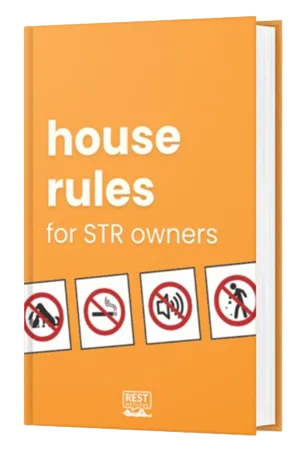
The house-rules template our team uses across the portfolio — clear enough to prevent problems, friendly enough to keep 5-star reviews coming. Copy it, tweak it, done.
🎉 Downloading now — we've sent a copy to your inbox too.
Book a free strategy call — we'll show you how our team would run and optimize your property, whether we work together or not.
Book a Strategy Call →