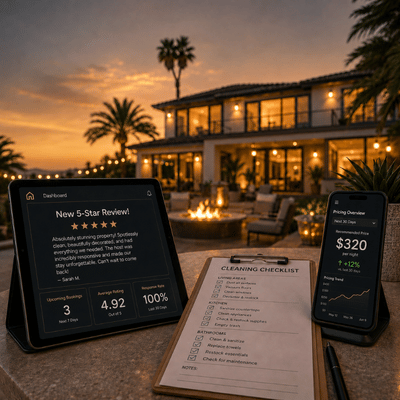
In today’s competitive short-term rental market, efficiency and automation aren’t optional—they’re essential. This episode dives into how top operators are eliminating fraud, increasing revenue, and creating seamless guest experiences through smart tech. If you’re still relying on manual processes or missing out on hidden income streams, you may be leaving serious money on the table…
Key Takeaways:
- How one operator scaled to 200 properties—and eliminated chargebacks entirely
- Why preventing fraud upfront is far more effective than fighting disputes later
- The real revenue opportunity most hosts overlook after the booking is confirmed
- How simplifying the guest journey can dramatically increase upsell conversions
- Why automation—not people—is becoming the foundation of scalable STR businesses
If you’re serious about scaling your short-term rental business, this episode is packed with actionable insights you can implement today. From fraud prevention to maximizing revenue per stay, it’s all about working smarter. Don’t forget to subscribe, share with fellow hosts, and explore the resources below to level up your operations.
Resource Links:
5-Star Guest Experience Guide with Charge Automation: https://corzly.com/5-star-guest-experience-blueprint/
DOWNLOAD OUR HOUSE RULES: https://strriches.com/airbnb-house-rules-template/
Download the Growth Handbook: https://strriches.com/growth-blueprint/
Check out our videos on YouTube: https://www.youtube.com/@ShortTermRentalRiches
Grab your free management eBook: https://strriches.com/#tools-resources
Looking to earn more with your property (without the headaches)? Chat with our expert management team: https://strriches.com/management-services/
Click Here to view Transcript
Well, welcome back everyone to the short-term Rental Riches podcast. I’m happy to be seated here virtually with yet another founder, a tech founder, uh, and a company we actually personally use in our portfolio. Uh, today we’ve got Thomas t Wald with us, and he is the co and founder of Charge Automation.
Welcome to the show, Thomas. Thank you. Thank you, Tim. And, uh, thank you for supporting Charge Automation, trusting in charge automation being a customer. So happy to hear that. Yeah. Yeah. And we’ve been happy. I know, uh, we’ve given you a few shout outs, uh, on the podcast Before, you know, the, the podcast is really just about how we’ve been operating our personal portfolio and growing and, you know, changing with the times.
And technology is one of those pieces that’s always changing, especially today. I mean, it’s at like warp speed. Um, but would love to hear a little bit about your background and, and, and how you got to be where you’re today. Um, so I think my background is very similar to a lot of people, how they end up in this industry.
Uh, almost accidental when I’ve discovered that, um, you know, um, renting a property short term is way more profitable than long term. Um, I used to be a real estate agent prior to that, so I’ve had some, uh, property and real estate experience and this is, um, way back in 2011. So Airbnb was just a year or two years old, so it was new industry.
Most people didn’t understand or they have never heard of Airbnb, the word. Um, and I, um, had some investment properties that I started doing short-term rental on, uh, quite early. And once I kinda discovered that it was a good profitable, um. Business. I scaled it up, um, doing, uh, rent arbitrage model. Um, and we’ve scaled to as much as, uh, 200 properties, um, very rapidly.
Um, and would scale comes, uh, bottlenecks and processes and the, the disadvantage that we have as property managers. Is that we don’t, we’re not like hotels where we have everything in one building. We have scattered, um, locations. So you can’t meet all your guests all at once when they’re checking in, uh, or different times of the day.
It’s just not scalable. And one of the biggest challenges that, uh, we were having at the time, um, was Airbnb was growing, but um, booking.com was already established and I was, I put my properties on booking.com, um, and we start getting a lot of reservations. So unlike Airbnb, but with booking com, you do have to process the guest credit card yourself.
Mm-hmm. Um, so. Uh, that I, and with pushing the credit card also comes a lot of, uh, frauds and chargebacks, things that you’re not really exposed to, uh, primary with, uh, Airbnb. Right. And given that I’m a software engineer by education, I built a, a tool to help me, uh, collect the payment automatically for my guests, and at the same time do an extra authentication verification process when collecting the payment.
Um, and that kind of eliminated our fraud chargeback. And we, we literally, and at scale, we were doing about $20,000 that we’re losing chargebacks, uh, a year. Wow. And it literally went down to, to, to zero. Um, and we’ve added a little more, um, you know, guest verification process along the way. So that kind of reduced a lot of our issues that we’re having with our guests and frauds.
Um, and that was pretty much the beginning. Um, and when other hosts in the community kind of discovered about my tool that was having the same issue, Hey, you know, can I use your, your, your, your software? Uh, ’cause I’ll have the same issue. And funny enough as, uh, our first client or person that reached out to me was all the way from Australia.
Uh, I’m in Canada. Mm-hmm. And they had 600 properties. And far was the biggest issue, uh, they had and they said, I want your software like yesterday. Um mm-hmm. So there a bit of modification for them to be able to use it. And we did that. Um, and the revenue, you know, from that customer was about 10,000 a month.
Um mm-hmm. Which was pretty, uh, exciting. And I, I realized that, okay, there’s something here that people need and want. Um, and I start really to focus on the software component of it building, you know, there. What started as a payments and verification component that, but then, um, the customers start saying, Hey, since you already have the credit card on file, since you already have, you know, doing all these things, can I also have ability to sell extra services?
Like, you know, airport pickup, uh, early check in, late checkout services. Um, and then we’ve added that component. And then they say, Hey, you’re already doing this. Can I also ask them a little more questions about why they come into my property before they arrive? Then we added ability to add some custom questions as a part of the check-in process, and then they said, okay, you’ve got all of this.
It’s amazing. But once they do all of that, can I have like a guidebook where they can read the checking instruction and get the access code, and then we added a guest portal or guidebook. And there was no definition of what we’re building at the time was brand new, but it is what’s known as right now, guest experience software.
So we kind of built it accidental, but also, you know, uh, product led growth where our customers are requesting, um, for, for, you know, what, what they want software to be. And, and they built it. And this is what it is now. It’s a full guest experience solution that handles everything from checking to checkout once the guest makes a reservation.
Yeah, exactly. And so yeah, you built it first for your own portfolio, solved some problems. Uh, obviously lots of other people in the industry have the same problems and now here you are, you’re a software company. Exactly. It is software company. So yeah. Such a long answer for short question, but yeah. No, but, but your guys’ tool really does a great job at, you know, facilitating all of that.
Um, and you mentioned, you know, one of the big things, chargebacks and maybe, you know, for the operators out there that are just getting started or they maybe have one or two properties and haven’t made it onto booking.com, or they haven’t made it onto these direct booking platforms where we always take the payments.
Maybe chargebacks doesn’t seem like a big thing, but once you get to that stage and if you’re planning on growing your portfolio, I mean, they are. Dramatic. You know, someone stays at your property and essentially the chargeback is they go to the credit card company and say, Hey, this was fraudulent, or whatever.
They dispute the charge and the credit card co company gives ’em the money back and you’re out. You, you had someone stay at your property potentially, and uh, they stayed there for free, so. It is a massive Im, it, it’s, it makes a massive impact. It is, and I, I mean, I’ve had many, many stories. Um, and it’s not just a chargeback.
I mean, that’s one component of it. So one is obviously the guests, uh, you know, stayed enjoy their estate and then they filed a chargeback. Now you lost our money. But then typically those kind of guests are also trouble. So they will smoke in the unit, right? They’ll throw a part in the unit. They will, they will, yeah.
Destroy the place. Um, so your cost is not even the chargeback, it’s the whole process. And you have to block the property for a certain period of time. You’ve gotta cancel the next booking. It is extremely painful. Um, so if you can prevent it, uh, prevent it. And most people think that if I can just, um, have all the evidence, I have pictures that this person stated in my.
Property, I’m gonna win this chargeback. Um, unfortunately, you know, 99% of the times you don’t win those chargebacks. Um, right. And they’re fraud. It’s a hundred percent you don’t win. So, um, it’s better to avoid than trying to win it back. Right, right. Exactly. Yeah. They often are not sure most favorite guests.
Yeah. So having that go guest authentication upfront, uh, really goes a long way. Mm-hmm. Um. Let’s see here. So where do we wanna take this next? I know there’s a lot of different ways we can go. Uh, chargebacks is definitely a big one. Um, you know, payment gateways and sort of automating that. I think the reality is, is that the.
There isn’t unfortunately a single tool out there that does everything perfectly or everything in the most efficient way. Uh, and so one of the reasons we came to charge automation also is for your just payment gateway, um, you know, to have a, a more reasonable fee for processing charge, uh, charges with Stripe.
Can, can you talk about kind of what that payment gateway is for those of our audience? Probably don’t know. Yeah. I’m glad you touched on that point. So. I think most, uh, PMSs typically support one or two payment processors, usually Stripe plus somebody else. Um, and. If you’re using Stripe, obviously you could use charge automation to be able to be able to collect the payment and avoid fraud chargebacks, um, and save some fee along the way.
Uh mm-hmm. But let’s say you are in a country where Stripe is not operating or you’re in a country where, uh, you know where Stripe has banned the, or, you know, close your account for whatever reason that may be. So now you’re stuck. Now you, you need to work with another payment processor, but the problem is that does that payment processor that you want to work with does not work with your PMS.
And this is almost accidental also how we we, how we got into this Because the customer came to us and said, Hey, Stripe closed my account. Here’s the payment processor I want to use. Here’s the PMs I want to use. You know, can you do this for me? Connect. Connect this two. And then we’ve pretty much been able to integrate that new payment processor where we connect the PMS and the payment processor with the bridge and the logic in there.
Um, yeah. And pretty much every customer that came in requested for another one and for another one, and for another one, before we know it, we have over 120 payment processor integrations. So now anybody from any PMS can use pretty much any payment processor in the globe, um, which is wow. Uh, like I said, it’s accidental, but it opens a lot of, um, opportunity for people to be able to choose the PMs they want to use and the payment process they want to use without having to compromise either one of them.
Yeah. That’s amazing. Wow. So you guys work with 130 payment processors? Yes. Under 30 plus now at the stage. Wow. That, that seems like a lot to keep track of. Uh, I’m sure some of them are more commonly used than others, but how, how do you guys manage all of that? You know, it, it, it’s when you’re building it, you don’t realize it.
And then when we have to maintain, update the APIs and changes, it’s really, it becomes, um, a handful I would say. Um, and we’ve kind of, I mean, after building so many, you, you do have a process. And some of them are just one-offs. ’cause, you know, one customer with a large number of portfolio properties wants to use it and some of them are like concentrated where a lot of people use it in certain countries.
Yeah. Um, so, um, we, we don’t keep and maintain all of them. We, we see that the activity, the usage, and there, there’s still customers using it. Then we continue to, to make updates. But some of them customers don’t use them anymore. They just, you know, staying there. So those ones we just kind of. Keep them, um, off the shelf until a customer wants to use it, then we may have to, you know, update some of their content.
Gotcha. Gotcha. Okay. Well, most of our audience is in the US and most of the short-term rental operators, owners, investors are using Stripe. Curious to hear from you. What are maybe like the top three payment processors that you see out there in terms of functionality, flexibility, and, and maybe pricing, you know, what are the best ones?
Well, I would say. I think, like I said, Stripe is a default one because it’s, it’s already available in the PMS. It is the easiest one to get an account with. Um, but it’s also not the cheapest. Um, so most, most people, um, go with that at the default. But once you scale up and once you start doing. Some serious volume.
Um, then that extra, you know, 1%, that extra half a percent, uh, you’re paying, uh, becomes significant. Uh, when you, when you do the total. And that’s where then people start evaluating. What other options, you know, are there? Um, and this is where, I mean, um, in us, you know, obviously authorize.net is a, you know, a second probably most popular one, um, in the industry.
Uh, but also a lot of like, um, big payment processors, whether it’s Chase Payments, um, or there’s Elon, um, a handful. Um, I mean, a quick Google search will probably give you those ones, but, uh, these are some of the popular ones. Um, that, that, that we work with. And most people usually switch, uh, from Stripe if they, if, if cost saving becomes an important factor.
Mm-hmm. Um, and, and, and we’re the, and we’re the pretty much, I would say, the only company in the industry that’s solving that problem at the moment. Yeah. Yeah. Yeah, the more properties you add and the more direct bookings you do, or the more you know bookings you do outside of Airbnb, or if you’re taking payments directly on booking.com, the, the more important these, these little percentages, uh, become, um, right.
You know, and that’s just another way for us in the industry to be more efficient and to have more net profit. And I think a lot of people out in the industry right now are, there’s a lot of buzz about upsells, you know? Mm-hmm. Uh, I think just because the industry’s gotten so competitive and people are trying to find ways to, you know, squeeze a few extra dollars out.
Uh, but this is one of the things that charge automation does really well. Uh, and helps facilitate. Can you tell us a little bit more about, you know, what you guys have built and, you know, chargebacks in general, or not chargebacks, I’m sorry, but, uh, ourselves. Yeah. Yeah. So there’s a general shift in the industry, uh, because it’s gotten very competitive and now the old school way is, you know, let me maximize, um, my A DR, right?
Um, and average daily rate, right? But I think how you have to think about the new way of thinking is not about, you know, how much you’re making, uh, for that booking, but it’s how much you’re making for that stay. So, so you may be competitive on the rate, but then you have all the additional ancillary revenue opportunities where you maximize that booking.
So that booking might have been a $2,000 booking, but by the end, that stay end up become a $3,000 stay because the guest has spent on a few different I items, so. Mm-hmm. Whereas you might have lost a customer if you had priced your daily rate at very high, but not have any upsells. So it is a competitive strategy and it is, uh, the modern way of competing in, in the, in the competitive SDR industry, uh, even the hotel space.
Um, so having said that, um, that’s where then you wanna see, you wanna optimize your upsells, you know, how do you drive maximum conversion, upsell. And one of the biggest, uh, friction point in upsells is when you present the guests, uh, an opportunity to buy upsells. A, you don’t wanna bombard them with hundreds of upsells or like some third party website where you just load up everything.
It has to be very curated. Um, and then from the curated point of view, once they wanna select, you want to show the credit card that they already use with the reservation on at the same level. So you give the Amazon experience where when they see the payment methods already attached, it becomes a one click up.
So where you just add and complete the payment. Right. But if you ask the guest to pull out their card and enter the numbers again to complete that payment. Now, statistically, uh, and this is a, a data, um, that was on done on research is it’s about, uh, 17% loss when you don’t have the payment method on file in the conversion received.
Yeah, so, so now if you have the card on file, you’re converting 17% more, um, which is, which is huge. So you’re giving the Amazon checkout experience. Um, and then the second part is. D you have guests coming from different parts of the world and they’re used to paying the way they, they pay locally. So you want to give that local payment experience.
So if they’re used to paying by Apple Pay, give them an Apple Pay option. Uh, Google Pay, uh, if they’re from Brazil, let’s say they, they don’t wanna pay by picks if they’re from, um, mm-hmm. Uh, let’s say someplace in Europe, um, like Holland, uh, it’s, they pay by ideal. That’s the way of people have people pay.
So not everybody takes just raw credit card numbers as a way of payment. So adding that, and I can’t remember the conversion, but I think it gives you another seven, 8% better conversion. Um, so, and that’s what we do. We charge automation, is that we give the guest ability to pay. You could be using Stripe, you could be using any payment processor, would give the guests a chance to pay through all.
Preferred payment methods and based on where they are and based on their browsers and location, we’ll load up the payment method that is used by the guest, so he’s more likely to convert and pay that upsell. Uh, and with that, uh, what we looked at is so far our customers are paying, spending over $180 per reservation in additional upsell revenue.
Um, mm-hmm. Uh, which is huge. And if it, you know, so if a property is taking, uh, four or five reservations for the month and you’re already at, at a thousand plus, uh, an upsell income, but all these little optimizations is where you maximize not having, Hey, I have an upsell. I could sell it. But it’s how you sell it.
How you convert it is, is, um, is the most important part and. You know, we’ve spent years and years, you know, optimizing those things and looking at the data and what’s working, what’s not working, AB testing to say this is how customers are converting. So, um, using professional tools is what helps you convert more upsells.
Yeah, definitely. Yeah. Some excellent points there. I, I know there’s. Just over the years, over the last decade, there’s been so many guidebook options that have come out and, you know, they’re all helpful for the guests and the guests like to see extra information, but removing those steps, basically, you know, making it easier for someone to, to add things on.
I, I think getting the reservation in the first place. Is one thing, you know? And yes, you’ve gotta have competitive pricing and make sure you know, you know what you’re doing with your revenue management, know what your market’s doing. But then it does create a whole bunch of opportunity after you already have someone, and I’m sure, you know, depending on your market, you, you could come up with some data on, you know, how likely it is for people to purchase the airport transfer, how likely it is for people to, to purchase the chef service or whatever it happens to be.
Mm-hmm. Um, to really raise the overall net income. Right. Yes. Uh, go ahead. Yeah. Um, and so, yeah, making that easy is, uh, is a big part. I know before we were with charge automation, we, we tried a lot of different things. You know, the PMSs have their own versions of upsells. Uh, there’s other options out there.
But storing the credit card information, like you said, making it easy goes a long way. Goes a long way. Indeed, indeed. Um, and also, uh, when, uh, people are on vacation or on a business trip, I know they’re not there to read paragraphs of your, your guide or, you know, along information. Um, and the old way of doing it was like, you know, when once a guest books, you know, they will receive five messages, you know, and it will be like, Hey, here’s a link to complete your check-in.
Um, here’s a link to do, uh, ID verification. That’s a separate one. Oh, and if you wanna read our, our, about our, about property, here’s a link for it. Um, and if you wanna buy some services, here’s another link. So now you gimme four or five different links, uh, as a and as a guest, I, I don’t want to think, I just wanna, you know, know, do what I have to do, uh, without much thinking.
So. Of combining all that, you know, fragmented experience for the guests into like one smooth process where they don’t think, they just click, click, click, and, and they’re done with it, uh, is the way. Um, and like I said, the last component of the, the check-in is once they complete that process, they do, I know online checking.
Um, and they pay the secure deposit or the balance. They buy some extra services. Um, and then the last step is, uh, give them access to the guidebook where they can see the information without. Changing the links without going somewhere else. Just keep it in in the same journey. Yeah. Well that’s, it’s a big part of the guest journey.
What you guys have tackled, you know, from payment to, to upsells, to guidebooks. What do you, what’s next for charge automation? I mean, what’s the next big, uh, thing to tackle? Good question. Uh, so, uh, I mean, we have a lot of exciting stuff that, that we’re working on. I can’t just talk about yet. Um, but. In terms of, uh, the product, um, you know, we’ve been at it for quite some time.
Um, you know, I think almost, almost, uh, almost 10 years now. So it is very mature product from that point of view. Um, but at the same time, you know, we are still a company that’s working, like we’re an early startup. Um, we add, um, I think on, in every sprint, which is our sprints about, you know, uh, about a month or so, uh, in every sprint we know we we’re adding about.
50 60 improvements or features, uh, to our product. And it’s changing, uh, drastically, uh, every time. And this, at this point, it’s more, it’s not more one of the big things, but it’s more like on the micro little things that really impact the guest experience. How do you make everything extremely smooth without, you know.
And it’s every, any friction at all. Um, yeah, and it’s just, yeah. So it’s a, it’s a micro fine tuning. Uh, our solution is what we’re focusing on because we’ve tackled all the big important items and then making it to work very seamlessly with your PMS. So, you know, you’re not spending too much time switching tabs.
Everything is, you know, readily available to you. Um, so all this little increments, incremental improvements that we’re doing is our focus.
Yeah. Um, well, I know. Software has just gotten easier to make now, you know what I mean? It’s exciting. We can use AI to help us code and, and do things much faster. I’m not a developer, but, uh, I, I do like technology and I, I try to stay up to date with things. How do you see our industry playing out? As someone who’s been in the software side of things for the last 10 years, knowing that there’s lots of operators out there, especially the larger operators trying to do some of these things in-house, you know, or maybe they’re just like you have done over the last 10 years have have solved one little problem and then that turns into two or three.
How do you see that, uh, changing just the software landscape, I guess, in our industry? Yeah. And this is, this is. Much bigger question. Um, because we literally we’re talking about like, you know, how does, how’s AI gonna change our industry? Um, ’cause that’s how, you know, things have gotten much easier and faster to build.
Um mm-hmm. And what I’ve, I’ve, I’ve noticed is, you know, and we have some customers have also know, built some aspects of our product, uh, you know, in, in house. Um, so what’s gonna happen with, with our industry is that a lot of hosts. Uh, who built their own little product and they wanna expand it. You might be able to do 80% of the work, uh, fairly quickly, but then for the last 20%, for the all the little incremental changes that you’re going to do, uh, that’s where really, you know, where, where it begins.
And the way, the way to give you, um, an example is like if you’re building a house. You can easily just put up the brick, um, you know, or the concrete very easily. Mm-hmm. But now you gotta do the wirings and, uh, you know, the drainage, um, all the little things, you know, the, the tiling and there’s all this extra finishing.
That is gonna take you a lot more time. So they might kind of save money by doing in house, but in the end they would have to hire someone. They have to maintain it. So I don’t think it will become cheaper. They might have the con the you, you might say, you know, I’m gonna take the house and build it, but I don’t think it will be cheaper necessarily.
So it’s not a cost saving strategy. Yeah. Uh, if you have a plan to sell that product to somebody else. Uh, maybe, you know, there’s a bigger picture, but to build it in house. To continue to maintain it. And remember, I mean, there’s also security issue. There is, you know, maintaining servers, um, you know, DevOps, uh, I mean, it’s a much bigger project, right?
Um, that this is so, uh, companies who are doing it, like, you know, again, if you wanna build software tech company, yeah. You know, you can build things, uh, faster and then keep investing. But I look at it from our side, you know, you know, we use AI in all our developments at the stage. And we’re building things there and doing a lot faster, but I cannot see how it would be cost saving for someone to bring it in house.
Yeah. Yeah. Gotcha. Not quite there yet. Yes. Lots of, uh, uh, yeah. Well, awesome, Thomas. Um, let’s see. I’d love to hear you have your own personal portfolio that you’ve had, you mentioned, and that’s kind of where things have started. How do you mind talking about your personal portfolio, just for a few minutes and, and kind of how that’s changed and what you’re doing to, to stay competitive?
Yeah, so. I’m, I’m a user first. Um, and, you know, with my own product, uh, we, we use before things get released to the public, you know, we use my own portfolio product. Uh, and it used to be about 200 post COVID, you know, I went down to, to, uh, about, uh, you know, 80 or so. Um, and we use this as, as a testing ground, uh, for from, for a lot what we built.
And I, I really experienced everything firsthand and everything that we, we built it is to, you know, benefit my operation, which means I know by internal I’m benefiting, um, um, other companies, uh, as well because everyone has the same issue. Uh, and. Also, yeah, I’m at the stage where also I’ve been, I’ve been a host, uh, for about, you know, almost 15 years now, right?
Mm-hmm. Um, and I have a lot of deep, deep experience, uh, in, in the operation. And I, I live it every day, so I. To me, uh, optimizing every single component of, of the journey is, is what’s important. And then maximizing the revenue. Um, and it’s gotten very competitive. It’s got, you know, it has, and I realize it will not get easier.
So now you have to think of creatively how to do this. Um, and, and there’s obviously, I mean, there’s the pricing tools. There is. Uh, know in, in the, in the upsells, how do you want to test it out? You know, does it make sense? And then how much did I make? So I’m doing a lot of this research, uh, internally with, with my own, uh, before, you know, concluding if this is a better way to, to do it.
I don’t know if you, if you have any specific questions about how, how, uh, I’m doing anything else, but, uh, generally, uh. I think what I’m building is, uh, you know, what the product charge automation is, is, uh, this direct outcome of my own operation. Yeah. Well, a lot of good points there. I mean, um, yeah, the industry’s definitely gotten harder and, and returns used to be really good, and now they’re getting smaller and smaller, you know, as more people discovered short-term rentals.
And so we have to learn ways to be more efficient. We have to embrace technology and we have to learn ways to create better guest experiences. Um, and then outside of that, I mean. There’s a supply and demand equation, you know, in a lot of these markets have just seen a lot of supply growth. Um, yes. Mm. And you know, my, my philosophy, uh, in my operation is I don’t trust people.
Um, I trust process. Mm-hmm. Um, because I’ve been through a lot of stuff. People, you know, people get sick, people leave, quit. People do different things. So you can’t build a business around people. Um, there has to be a process whether that person is there or not. Business has to keep going. And I’ve built, um, no, the automation is really, does not rely on a person that doesn’t rely on a person’s knowledge, uh, or experience.
It’s really a process and, uh, and my goal is how do I create a business that, uh, can operate? Whether that person’s here or is not there, and how can I operate it with as little people as possible? Uh, because that saves you money, it saves you headache. And in a competitive space, you know, uh, human labor is the most expensive thing.
And if you can save that, then your, you know, then you can com You can stay competitive in, in this, uh, in this tough, uh, in the competitive industry. Yeah, for sure. Yeah, those are, we share a lot of those same ideas. I mean, that’s our idea behind quarterly is, you know, making things more efficient, using more technology, and, uh, excited to see where you take things with, with your, with your software companies and with your portfolio.
And would love to stay connected. Uh, how can, how can people find you and, uh, what’s the best way to get in touch? Uh, so best way to get in touch, uh, again, we have, uh, again, by email. It’s, uh, thomas@chargeautomation.com is, uh, the best way to reach us or our website, charge automation.com, uh, where you can find, learn about our product as well.
Uh, and I really wanna say yeah, and then thank you for giving us this opportunity. Uh, and, you know, it’s, it’s very, very good end. To see a customer that’s using our, our product. Um, and also, you know, to, to discover that you have a podcast and be part of it is, is quite exciting. So, uh, I would like to say thank you for this as well.
Ah, you’re welcome. Thanks for coming on and, and look forward to staying in touch. Thank you. Cheers. Thanks, Thomas. Bye-Bye.