Starting November 20th, Airbnb is limiting what you can put into your Airbnb house rules. No fines, no surprise fees, no checkout chores, and most rental agreements and ID checks are out.
Download our updated Airbnb House Rules Template
This episode is for Airbnb hosts who need to update their Airbnb house rules. We walk through the 7 rules you can enforce, what becomes a request, and how to protect your property. You'll know exactly what to change before the 20th.
Airbnb now only allows you to have seven rules. Seven rules governing your property and the rest anything else that you had now just become requests that your guests can ignore. Today we're going to walk through all seven. What happens to all the other rules that you want to put in place and how to make sure that you are still covered if there's any sort of guest damage. Airbnb recently announced their big change to house rules. It takes effect November 20th, 2026. If you had bookings before
that date, then your prior house rules are still applicable however which way you had them set up. But for every single reservation you get from November 20th going forward, you only have seven rules that you can apply. So your new house rule list now has two parts. So, actual rules and then requests. The way it reads from Airbnb's website is that guests must follow host house rules and are encouraged to comply with host requests. So, if a guest breaks one of the house rules, one of
the seven house rules, you can cancel without penalty. You can cancel their reservation. But if they break one of your requests, you cannot. A big update that also has a lot of people freaked out is that Airbnb says you have to have all of your policies on their website. You can't have anything after the fact. You can't have it in your property, for example. These are their words. Hosts may not communicate new house rules or requests in other sections of their listing page or after booking,
implying that they can't do it in their actual physical property as well. So, that means no new rules when your guests show up at the property. No signs with any sort of rules outside of Airbnb's policies. I know this sounds kind of crazy, but believe me, we're going to make sure that you're covered. Let's first go through these seven house rules, which the house rules on Airbnb is really your rental contract. It's your agreement, right? Whereas we have one on VBO and Booking.com and on our
directbooking site. I hope you guys have all those set up. This is Airbnb's version. And so, these are the seven rules that you can actually enforce. So, here's the first one, max overnight guest. You can still enforce this, but you can't have any sort of lingo on there about fees that you will apply if they exceed that. That all needs to be upfront in your actual listing in the form of an extra guest fee. Number two, quiet hours. This one's always been there. Ours is at
10 p.m. Depends on your property. If you're out in the country and you have no neighbors for 100 miles, then maybe you don't even have any quiet hours. But if you have an inner city urban apartment with neighbors close by, we keep ours at 10 p.m. Number three, events. You can enforce no parties at your property. Number four, pets allowed, yes or no, and how many. What you can't put in this rule, at least in this section, it has to go in as a request, is
the type of breed, and whether it's a cat or it's a dog or it's a little bunny rabbit. If you previously had any additional notes on pets, like whether the guests had to keep them crated or if they were allowed on furniture, those types of things, then those all go in requests. Now, if you're new to the channel, well, we've been doing this for a long time. You can go to strries.com and catch all of our prior episodes. Or if you're looking for help with your
property, you can go to our company, our management company, corsley.com. Number five, smoking and vaping. You can enforce this policy, but what you can't do is now have an explicit fee if someone's caught doing it. Doesn't mean you can't charge them. We're getting to that in a second. Number six, this one might be newer for some of you, but commercial photography. I know our team has had lots of requests for this in the past, have approved it with certain stipulations, uh, but this is one of
the seven house rules. Now, you can enforce whether or not you want that happening at your property. Number seven is lock up at checkout or checkout procedures. You can't ask people to do chores anymore. Fill the dishwasher or strip the beds. You really shouldn't be asking your guests to do those things anyways. The industry has changed a lot. And if you haven't taken a glance at your competition recently, most people aren't asking our guests to do this. So, it really catches our Airbnb guests offguard. Now,
every channel is different, of course, right? So maybe a guest coming from VBO is a little more used to this with traditional vacation rentals depending on the market. But in general, we shouldn't really be asking our guests to do things, especially when we're charging them a cleaning fee. So in terms of checking out, the only thing that you can ask your guests to do today or as of November 20th, depending on when you're watching this episode, is lock up your property. So that's it. Those are
the seven rules that you can actually enforce. We can still have lots of requests. A couple other ones that you may be thinking are actual rules, but they're not are exterior cameras. That's something that's already built into Airbnb's safety policy. So, that one's kind of already handled. Another one you think might be in these house rules or should be in here, but it's actually already built into Airbnb is their exterior camera disclosure. So, that's built into their safety. Everything else is now becoming request. So, let's
go ahead and jump into that. According to Airbnb's policy, they say that hosts generally may not ask guests to complete tasks that require significant effort or time. Now, what requires significant effort or time is really up to your discretion. Maybe you keep all of the other rules that you had on there as rules, but now just leave them as requests. So, if you did ask people to wash dishes, which again I highly don't suggest, then you can request that they do that. If you ask them
to take the trash out, then you can request that they do that. If you asked that they don't leave their pets alone or allow them on the furniture, then you can request that they do that. If you copied our house rule template in the past, then you had another rule that said if you're a local or you're under 23 years old, please contact us first. Now, we've always known that this one wasn't actually enforceable, but we had a lot of people contact us beforehand. One other
way to make sure we're getting good guests staying at the property. If you haven't seen our house rules yet, well, we have an updated version now with everything that can be house rules and then everything that should be requests. It's quite extensive. You can scan the QR code here to get your copy. There's no strings attached. Covers all the ones my team and I have come across managing thousands and thousands of guests. All right. Next up, let's talk about fines. when something doesn't go right and
what Airbnb is referring to as surprise fees. Airbnb says pretty straightforward on their website. Host generally may not impose fees or other penalties on guests. Any fees for an advertised part of the listing must be included in the price shown to guests at the time of booking. So, we all know that fees don't actually get detailed out on Airbnb anymore. Our housekeeping fee doesn't show up, for example. But, you still have the option to add in a pet fee. you still have the option to add
in a extra guest fee. And so you want to make sure you have those in there if that's a rule that you've stuck by before. So some of the ones we're having to strip from our house rules right now. Doesn't mean we're not going to charge for them, but we can't have them in the verbiage. Previously, we had a $200 per night if someone was caught smoking or there was evidence of smoking in one of our properties. We had additional cleaning fees. We didn't really have
that specified as a specific number, but we often charge that and we still can. We're going to get to that in the next section here. A lot of our properties had damage waiverss, which even though you can't charge this upfront anymore, you can still purchase a damage waiver on the back end from a company like Safely or WEO to help you cover all sorts of incidentals that maybe don't get covered from Airbnb's built-in damage protection policy, like air cover. Remember this is just Airbnb, right? So
all these policies, all these rules, you want to make sure that you have these on your directbooking site, that you have them on VBO, that you have them on Booking.com, Google, all the other places where you're listed. This just applies to Airbnb. And I would say Airbnb's resolution center, if you know how to operate it properly, has been pretty good. In fact, it's been the best out of all the other OTAAS. So I don't want everyone to get really freaked out out there. This doesn't mean
we can't be charging people anymore. We're still going to go through all these processes like we should have been all the while along. It's just the rules are changing a little bit and we've really got to ask ourselves here, what is the alternative? Well, we don't really have an alternative. Airbnb spends millions of dollars on advertising, so our properties get booked and if we want to list on their platform, then we have to follow their rules. All right, so all of these damage type things can
go in as requests. Remember, we can't have the fees in there, but if there is actual damage at our property, we're going to charge for it. And how do we do that? Well, we do it the same way we've always done through the resolution center. So, if there's some sort of damage, you've got 14 days after checkout to make your claim, submit your evidence, and get reimbursed. If you're new to the resolution center or you haven't had really good outcomes in the past, well, go back
and check out our episode 342. We talk about our team's process for doing it and we've got a really good win rate if after you submit a resolution and either gets declined or the guest doesn't agree with it. Well, then we want to escalate to air cover. And remember, basically all damage is covered, right? If someone damaged your property, you need to make sure you have really good photos. So, I hope your checkout process is topnotch. Make sure you're getting photos. Make sure your housekeepers are
taking photos. If you want to charge $200 for someone smoking in your property because you found evidence and that's what you were charging before, then you need to create an invoice. You need to show proof that you had a housekeeper there doing extra tasks. And maybe that cost you $200. You put it on the invoice. And I'm pretty sure we're still going to come out the same way we have always with these resolutions. Next up, this is a big one. We have contracts, guest IDs, and
local laws. Good news. If your state or city has some sort of law that requires you to collect an ID, requires a different contract or agreement, then you can still enforce that. Airbnb cannot prohibit you from doing that. And I know there's a lot of places out there like that. So, you just need to make sure you review your local regulations. In Airbnb's words, they say host generally may not ask guests to sign a separate contract or rental agreement unless there is an exception required by
their local HOA or for optional amenities like renting a golf cart or something like that. Also, if you have a lug stay or a stay 28 days or longer, then you can have a separate rental agreement. Airbnb also says that with limited exceptions, hosts may not solicit personal data at any point during the booking process or stay. This really isn't new news, right? They've been trying to do this for a long time. My suggestion, you keep your same QR codes in your property that allows people
to see that you have a direct booking website and you use Airbnb as an opportunity to help grow those direct bookings. A lot of guests are much more savvy than they have ever been, right? And so if they find your listing online and you have a good direct booking listing setup, hopefully with Google reviews and a nice presence, then they can find you pretty easily. If you're out there and you've been using apps like StayFi to collect guest data that way, well, my suggestion, you didn't
hear this from me, but I would just leave it and let's see what happens. Right? If you're getting a complaint from a guest, we don't even really know what's going to happen yet, right? If a guest says, "Hey, I had to enter my email to access their Wi-Fi." Is that going to result in some sort of crazy penalty? I don't really think so, but we don't know uh until we move forward. So, we'll have to stay tuned on that one. One little note, it says that
you can't require this. Doesn't mean that you can't ask for it. So, there we have it. There's the seven rules that Airbnb will allow you to enforce. Everything else becomes requests unless you're in one of those jurisdictions which has other laws which Airbnb cannot prohibit you from abiding by. Let's make sure that we really know how to use resolution center if something comes up. I don't think these new rules are just going to all of a sudden create a whole bunch of additional damage. Again, remember
we're all better off with Airbnb, right? That's why we use it. And I know after working with hundreds of other owners out there that for most of you, this is the majority of your bookings. And so we're playing under their terms. It's them marketing. Let's just make sure that we can handle these processes as best as possible on the back end. I don't foresee a huge difference or change in our operations. But if something changes in the future, well then we will change our operations. If
you don't want to handle all of this yourself and you want to make sure you're protected and you want to make sure that everything's getting overlooked, our team would love to help you with your properties, you can go to our website, cororsley.com. We handle the core operations with your team. You remain the owner, you remain in control, and we have the industry's lowest fee. We offer a lot of value. I would love to talk with you personally. There's a little partner with us button there. Until
next time, I hope you have a fabulous week.
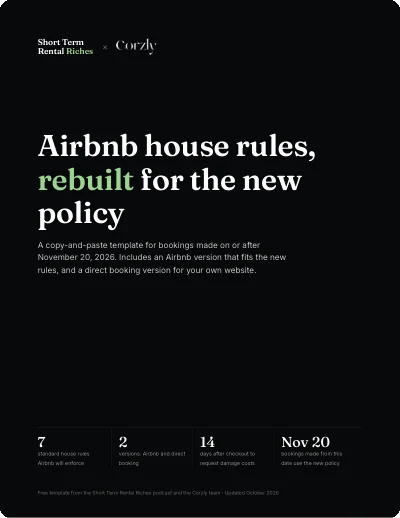
Airbnb rewrote its house rules policy for bookings made on or after November 20, 2026. Our team rebuilt the rules we use across our properties to fit it. Copy it, fill in your details, and publish.
🎉 Downloading now — we've sent a copy to your inbox too.
Book a free strategy call — we'll show you how our team would run and optimize your property, whether we work together or not.
Book a Strategy Call →